Answer Engine Optimization (AEO) & GEO: The Complete Guide to Winning Share of Model
A growing share of buying research now happens inside a single AI-generated answer. Here's how AEO and GEO work, how Share of Model is measured, and a concrete framework for getting mentioned.
Rohan Alexander · 11 min read · Updated July 2026
Quick Answer
AEO vs GEO vs SEO vs Share of Voice
| Term | What it optimizes for | Primary channel |
|---|---|---|
| SEO | Ranking position on a search results page | Google/Bing organic results |
| AEO | Being the direct answer to a specific question | Featured snippets, AI Overviews |
| GEO | Being cited or synthesized into a generative AI response | ChatGPT, Gemini, Claude, Perplexity |
| Share of Voice | Volume of media/advertising presence vs competitors | Traditional and organic media |
| Share of Model | Frequency, prominence, and favorability of brand mentions in AI answers | All major LLMs, measured together |
These aren't competing strategies. SEO fundamentals — structured content, clear entity information, authoritative pages — remain a prerequisite for AEO and GEO, since generative engines still draw heavily on well-ranked, well-structured sources when constructing an answer.
The Zephra AI Marketing Framework™
Zephra treats AI-answer visibility as the third and newest layer of marketing execution, sitting alongside — not replacing — paid and organic acquisition:
Why This Matters: The Invisible Funnel
When a prospective customer asks an AI assistant "what's the best [category] for a small business" and gets a single synthesized answer, they often make a shortlist decision — or a full decision — without ever clicking through to a website or seeing a search results page at all. If a brand isn't mentioned in that answer, it doesn't lose a ranking position; it's simply absent from the decision entirely, with no impression, no click, and no way to measure the loss through a traditional analytics dashboard. This is why Share of Model has emerged as a distinct KPI worth tracking on its own, separate from search rankings or ad impressions.
How LLMs Actually Construct an Answer
Generative engines don't crawl and rank a link graph the way traditional search does. When asked a category question, they draw on a mix of training data and, increasingly, live retrieval from the web — aggregating what multiple sources say about a brand and looking for consensus. A brand mentioned consistently and specifically by several independent, trusted sources is more likely to be surfaced than one that only talks about itself on its own site. In practice, this means LLMs aggregate authority; they don't generate it — if trusted third parties aren't already discussing a brand, the brand is unlikely to appear in the synthesized answer regardless of how good its own website is.
Share of Model: The Formula
Share of Model (%) = (Your brand's mentions across a set of category prompts ÷ Total brand mentions across all prompts) × 100
Example: if a business is mentioned in 15 out of 60 total brand mentions across 20 category prompts run through several AI assistants, its Share of Model is 25%.
Because model outputs vary between providers and even between runs of the same provider, a reliable measurement samples the same set of realistic prompts across multiple assistants (at minimum ChatGPT, Gemini, and Claude) repeated periodically, rather than a single one-off check.
Inclusion Rate and Resolution
| Sub-metric | What it measures |
|---|---|
| Inclusion rate | The percentage of relevant prompts where your brand is mentioned by name at all |
| Prominence | Whether your brand is named first, mid-list, or as an afterthought in the answer |
| Favorability | Whether the characterization is positive, neutral, or negative |
| Resolution | How specific and verifiable the content driving your mention is — models tend to favor specific data points and verified detail over vague marketing claims |
Step-by-Step: How to Optimize for AEO/GEO
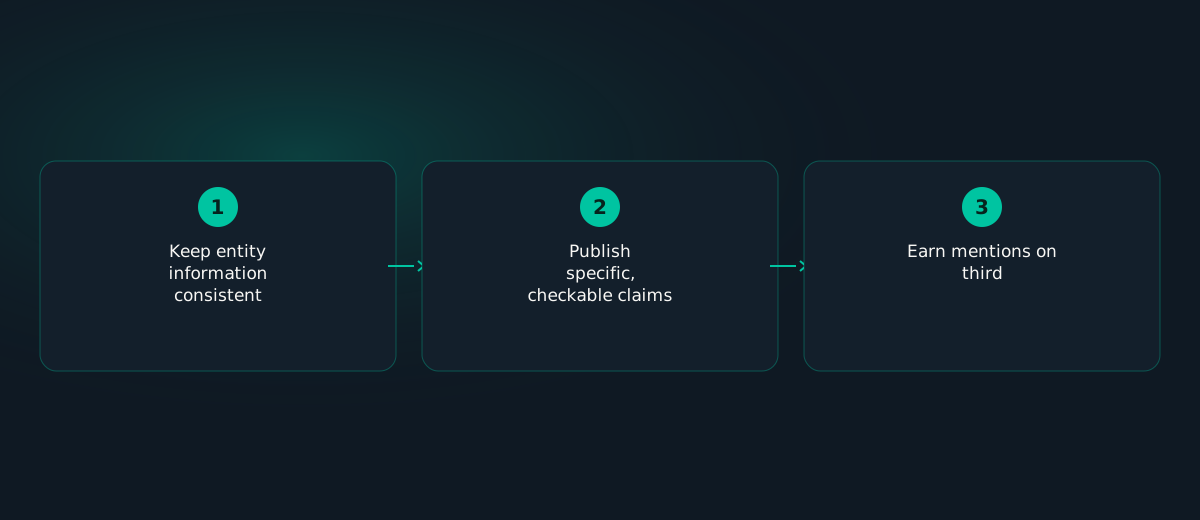
- Keep entity information consistent everywhere — your business name, category, location, and core claims should read identically across your website, directories, and any third-party coverage, so systems can confidently associate mentions with the same entity.
- Structure content around specific questions, not just keyword themes — write the exact question a buyer would ask an AI assistant as a heading, followed by a direct, one-paragraph answer.
- Use schema markup (Article, FAQPage, Organization) so both traditional and AI crawlers can parse your content's context unambiguously.
- Publish specific, checkable claims — real numbers, named methodology, and dated data outperform vague statements like "industry-leading" or "the best."
- Earn mentions on third-party sites your category already trusts — comparison sites, trade publications, review platforms — since LLMs weight independent consensus over self-published claims.
- Sample your Share of Model regularly using a fixed set of realistic prompts across several assistants, so you can track whether these efforts are moving the number.
Industry Variations
| Business type | What to prioritize |
|---|---|
| B2B / SaaS | Comparison and review sites (the categories buyers ask AI assistants to compare) |
| Local service | Consistent local directory listings and specific, named service-area detail |
| Ecommerce | Structured product data and genuine, verifiable customer reviews |
Case Study
A B2B software company sampled its Share of Model across 20 category prompts and found it was mentioned in only 2 of them, always in fourth or fifth position behind competitors with more third-party comparison coverage. Over one quarter, the team restructured its cornerstone comparison page around the exact questions buyers were asking, added specific, verifiable performance numbers in place of general claims, and secured mentions on three independent comparison sites already trusted in the category. Re-sampling the same 20 prompts three months later showed inclusion in 9 of them, with two mentions now appearing first in the answer rather than last.
Decision Matrix: AEO/GEO vs Traditional SEO Priority
| Situation | Priority |
|---|---|
| Website has thin or unstructured content, weak search rankings | Fix SEO fundamentals first — AEO/GEO builds on top of this |
| Solid search rankings, but rarely mentioned in AI assistant answers | Prioritize AEO/GEO — structured Q&A content and third-party mentions |
| Category where buyers commonly ask AI assistants "best X for Y" | High-priority AEO/GEO investment |
| Purely local, walk-in business with little online research behavior | Lower priority — traditional local SEO and reviews still matter more |
Common Mistakes
- Treating AEO/GEO as a replacement for SEO rather than a layer built on top of it.
- Publishing vague, unverifiable claims that AI systems tend to discount in favor of specific, checkable detail.
- Inconsistent business naming or claims across the web, making entity recognition harder.
- Only measuring one AI assistant instead of sampling across several, since Share of Model varies notably between models.
- Expecting results in weeks rather than the months this typically takes to compound.
Troubleshooting
Brand never appears even for clearly relevant prompts: check for third-party mentions — if independent sources aren't discussing the brand, self-published content alone rarely changes AI-answer inclusion.
Brand appears but mischaracterized or outdated: check for outdated or inconsistent information across the web — old directory listings or stale reviews can outweigh a recently updated website.
Strong in one AI assistant, absent in another: normal — models draw on different training data and retrieval sources; track Share of Model per-model, not as a single blended number.
Checklist
☐ Entity information (name, category, location, claims) consistent across the web
☐ Cornerstone content structured around specific buyer questions
☐ Article/FAQPage/Organization schema implemented
☐ Vague claims replaced with specific, checkable numbers
☐ At least one active push for third-party mentions on trusted category sites
☐ Share of Model sampled across 2-3+ AI assistants on a repeatable prompt set
AI Prompts to Speed This Up
- "List 15 realistic questions a buyer in [category] might ask an AI assistant when researching options — I want to sample our Share of Model against these."
- "Rewrite this page section to lead with a direct, specific one-paragraph answer to the heading question, removing vague marketing language."
30-Day Action Plan
| Week | Focus |
|---|---|
| 1 | Build a 15-20 prompt list and sample current Share of Model across 2-3 AI assistants. |
| 2 | Audit entity consistency (name, claims, location) across your site and top directories. |
| 3 | Restructure your top 2-3 pages around specific buyer questions with direct answers and schema. |
| 4 | Pursue 2-3 third-party mention opportunities; re-sample Share of Model to set a baseline for next quarter. |
FAQ
What's the difference between AEO, GEO, and SEO?
SEO optimizes for search ranking; AEO for being the direct answer to a question; GEO for being cited by generative AI systems. They reinforce each other rather than compete.
What is Share of Model and how is it measured?
It measures how often, prominently, and favorably a brand appears in AI answers vs competitors — commonly calculated as your brand's mentions divided by total brand mentions across a fixed prompt set.
Do backlinks still matter for AI visibility?
Yes, but brand mentions on authoritative sites, even without a link, appear to correlate more strongly with AI-answer inclusion.
Can a small business realistically compete for Share of Model?
Yes — AI answers reward specific, well-structured, factual content and consistent third-party mentions, which smaller businesses can often produce faster than larger, slower competitors.
How long does it take to see Share of Model improve?
Expect months, not weeks — similar to organic SEO, since it depends on accumulating consistent third-party mentions over time.
You can build and track this manually using the framework above.
Zephra is building measurement for this exact layer — sampling Share of Model across major AI assistants and surfacing where entity consistency or content gaps are holding a business back — so this becomes something you monitor on a dashboard, not something you check by hand every few months.
Start Free Audit →Sources & Further Reading
- WordStream — 2026 Google Ads Benchmarks Report — Current cross-industry CPC, CTR, conversion rate, and cost-per-lead benchmarks.
- Google Ads Help — About Smart Bidding — Google's own documentation on how Smart Bidding uses conversion signals.
Figures and platform mechanics referenced in this guide are cross-checked against the above as of publication; ad platform thresholds and benchmarks change over time, so confirm current figures directly with the source before making budget decisions.