Ecommerce Marketing Guide: How to Get More Sales From Ads
Ecommerce advertising lives or dies on three things: a clean product feed, an honest ROAS number, and a recovery plan for the majority of shoppers who don't buy on the first visit.
Vineeth N.A · 7 min read · Updated July 2026
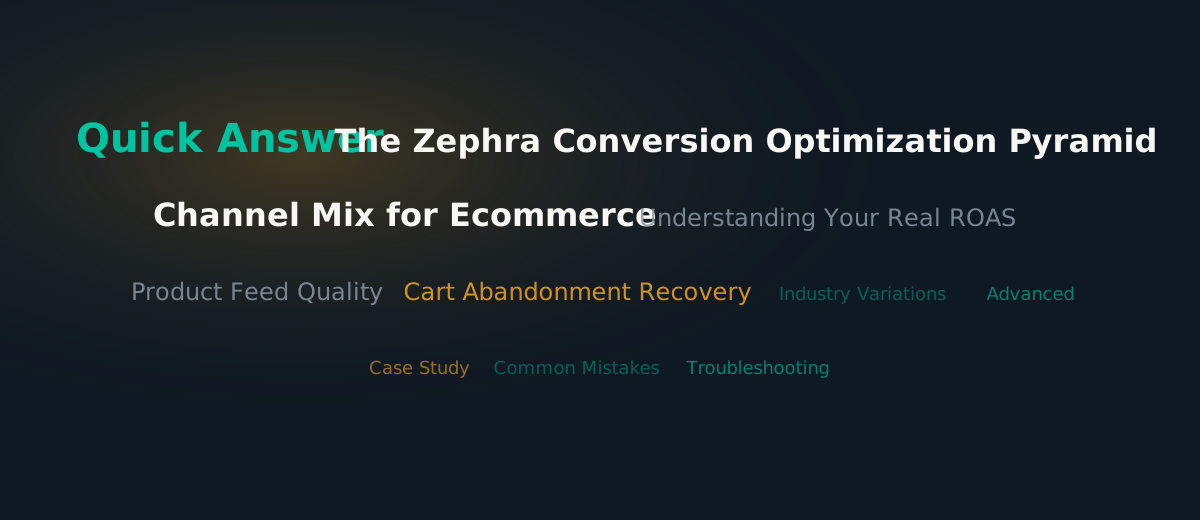
Quick Answer
The Zephra Conversion Optimization Pyramid™
Fix ecommerce conversion problems in this order — each layer depends on the one below it being solid:
Most brands jump straight to "Retention" tactics (loyalty programs, subscriptions) while their product feed or checkout flow is still leaking sales at the base of the pyramid — fix lower layers first.
Channel Mix for Ecommerce
| Channel | Role |
|---|---|
| Google Shopping | High-intent product search, visual listings |
| Google Search | Branded and generic product-category searches |
| Meta/Instagram Ads | Discovery, visually-driven impulse purchases |
| Email/SMS | Cart recovery, repeat purchase, retention |
| Retargeting (Meta + Google) | Re-engaging visitors who didn't buy |
New ecommerce brands often start entirely on Meta because setup feels faster, but pairing it with Google Shopping tends to outperform either channel alone — Shopping captures people who already know what they want, while Meta introduces the product to people who didn't know they wanted it yet. The two roles are complementary, not competing.
Understanding Your Real ROAS
Platform-reported ROAS is attributed revenue, not profit — and every platform tends to over-credit itself for sales influenced by more than one channel. Before judging a campaign, reconcile the platform number against your actual order data and true product margin (after cost of goods, shipping, and payment processing fees). A campaign showing 4x platform ROAS might be only marginally profitable once real costs are factored in.
| Metric | What it actually tells you |
|---|---|
| Platform ROAS | Attributed revenue ÷ ad spend — inflated by cross-channel double-counting |
| Blended ROAS | Total revenue ÷ total ad spend across all channels — more honest |
| Break-even ROAS | The ROAS at which you cover product cost and fees — your real floor |
A simple monthly habit that catches this early: pull total store revenue and total ad spend across all platforms, and compare that blended ROAS against the sum of what each platform individually claims. If the platforms' combined claimed revenue exceeds your actual total revenue, you're seeing the double-counting effect directly.
Product Feed Quality
- Accurate titles and categories — Google Shopping's matching depends heavily on feed data quality, not just bids.
- High-resolution images that meet platform size and background requirements.
- Complete attributes (GTIN, brand, size, color) — missing fields quietly suppress listings from being shown at all.
- Regular feed refreshes so pricing and stock status stay accurate — stale feeds get penalized or disapproved.
Cart Abandonment Recovery
Most ecommerce visitors don't buy on their first visit. A layered recovery approach recovers meaningful revenue that would otherwise be lost entirely:
- Email within 1 hour — a simple reminder of the exact items left behind.
- SMS within 24 hours — for stores with SMS opt-in, often outperforms email alone.
- Retargeting ads on Meta/Google showing the specific abandoned product for 3-7 days.
- A modest incentive (small discount or free shipping) in the final recovery touch, not the first.
Industry Variations: DTC vs Marketplace-Heavy Brands
| DTC (own website) | Marketplace-heavy (Amazon, etc.) | |
|---|---|---|
| Where ads matter most | Google Shopping/Search, Meta | Marketplace-native advertising (e.g. Amazon Ads) |
| Tracking control | Full — you own the Pixel/Conversions API | Limited — marketplace controls most attribution |
| Margin visibility | Full visibility into true product margin | Marketplace fees add another layer to reconcile |
| Retention channel | Email/SMS you own | Marketplace loyalty programs you don't control |
Brands selling on both channels often see their DTC site as the more profitable long-term asset, since it's the only place they own the customer relationship and full tracking — while marketplaces remain valuable for reach and discovery.
Advanced: Post-Purchase and Repeat Revenue
Once acquisition and recovery are stable, the highest-leverage lever is often repeat purchase rate, not more new-customer spend. A simple post-purchase email sequence (delivery confirmation → usage tips → replenishment or complementary product reminder, timed to typical reorder cycles) frequently produces a better return than incremental acquisition budget, since it's selling to an audience that already trusts the brand.
A useful benchmark to track: what percentage of monthly revenue comes from repeat customers versus first-time buyers. Brands that rely almost entirely on first-time buyer revenue are more exposed to rising acquisition costs, since every dollar of growth has to be bought fresh. Brands with a healthy repeat-purchase base can often sustain growth even if acquisition costs rise, because a growing base of existing customers keeps generating revenue independent of that month's ad spend.
Loyalty programs and subscription options are natural extensions of this once repeat-purchase behavior is established organically — but they tend to underperform when introduced before that pattern exists, since they're formalizing a behavior the business hasn't yet earned rather than encouraging one that's already happening.
Case Study
A DTC coffee brand's Shopping campaigns showed a platform-reported ROAS of 5.2x, which looked strong — but reconciling against true margin (product cost, packaging, and shipping) put break-even at roughly 3.1x, meaning real profitability was thinner than the dashboard suggested. Fixing three feed issues (missing GTINs on 40% of SKUs, stale pricing, and low-resolution images) improved impression share and cut cost per click by about 18%, pushing real (margin-adjusted) ROAS from 1.7x to 2.6x within a month — closer to sustainable, though it took feed hygiene, not bid changes, to get there.
The same brand then layered in a post-purchase email flow (delivery confirmation, brewing tips, and a reorder reminder timed to a typical 3-4 week coffee consumption cycle). Within two months, repeat customers accounted for a meaningfully larger share of monthly revenue than before the flow existed, reducing the brand's dependence on constantly rising new-customer acquisition to hit the same monthly revenue target.
Common Mistakes
- Judging campaigns on platform ROAS without reconciling against real margin.
- Launching Shopping campaigns with an incomplete or inaccurate product feed.
- No cart abandonment sequence at all.
- Running acquisition and retargeting from the same budget without separating their different jobs.
- Ignoring repeat-purchase and retention marketing in favor of constant new-customer acquisition.
- Launching loyalty or subscription programs before repeat-purchase behavior exists organically.
Troubleshooting
Shopping campaign showing zero impressions: check Merchant Center for feed disapprovals or missing required attributes before adjusting bids.
ROAS looks great but bank balance doesn't reflect it: reconcile platform-reported revenue against actual net margin — this gap is one of the most common and costly misreads in ecommerce advertising.
Repeat purchase rate isn't improving despite email flows: check send timing against actual product usage cycle — a reorder reminder sent too early or too late relative to when the product runs out will underperform regardless of copy quality.
Copyable ROAS Reconciliation Template
Platform-reported revenue: ____________________
Ad spend: ____________________
Platform ROAS: ____________________
Product cost + shipping + fees (%): ____________________
Break-even ROAS: ____________________
Real margin-adjusted ROAS: ____________________
AI Prompts to Speed This Up
- "Calculate break-even ROAS given a product cost of [X]%, shipping cost of [Y], and payment processing fee of [Z]%."
- "Draft a 3-email cart abandonment sequence for a [product category] store, sent at 1 hour, 24 hours, and 72 hours."
- "List the required Google Merchant Center product feed attributes I might be missing for [product category]."
FAQ
What is a good ROAS for ecommerce?
It depends on margin. A common rule of thumb is a break-even ROAS around 2-3x for typical retail margins.
Why is my platform-reported ROAS different from my actual profit?
Platforms report attributed revenue, not profit, and often over-credit themselves for cross-channel sales. Reconcile against actual order data and true margin.
How do I recover abandoned carts?
Email and SMS sequences triggered within an hour, combined with retargeting ads showing the exact abandoned product.
Why would my Shopping campaign show zero impressions?
Usually a product feed issue — missing attributes, a disapproved product, or a stale feed. Check Merchant Center diagnostics first.
Should I advertise differently on my own website vs a marketplace like Amazon?
Yes — on your own website you control tracking and margin visibility fully; on a marketplace, attribution and fees are largely controlled by the platform, and loyalty tools you don't own. Many brands treat their own site as the more profitable long-term asset for this reason.
Want your real numbers, not the platform's version?
Zephra's server-side tracking reconciles true conversions against platform-reported ROAS, and runs Shopping, Search, and Meta campaigns together from one product feed — with daily budget optimization.
Start Free Audit →Sources & Further Reading
- Baymard Institute — 50 Cart Abandonment Rate Statistics — A meta-analysis of 50 independent studies on cart abandonment rates and causes.
- WordStream — 2026 Google Ads Benchmarks Report — Current cross-industry CPC, CTR, conversion rate, and cost-per-lead benchmarks.
- Meta Business Help Center — About the Learning Phase — Meta's own explanation of what the ad set learning phase is and why it exists.
Figures and platform mechanics referenced in this guide are cross-checked against the above as of publication; ad platform thresholds and benchmarks change over time, so confirm current figures directly with the source before making budget decisions.