Marketing for Hotels & Tourism
Direct booking vs OTA dependence, seasonal demand planning, visual-first creative, and why reviews carry more weight here than in almost any other category.
Rohan Alexander · 30 min read · Updated July 2026
Quick Answer
Industry Overview & Economics
| Metric | Typical range |
|---|---|
| OTA commission | Commonly 15-25% per booking, directly reducing margin on every OTA-sourced stay |
| Booking window | Highly variable by segment — days for last-minute domestic travel, months for planned international trips |
| Target CAC | Should be evaluated against average length of stay and repeat-visit likelihood, not a single booking's value alone |
| Capacity constraint | Room/inventory availability by date — marketing intensity should flex with actual occupancy targets, not run flat year-round |
The Zephra Lead Quality Matrix™ for Hospitality
| Low intent | High intent | |
|---|---|---|
| High fit (right dates, right segment) | Retarget with direct-booking incentive messaging | Fast-track: streamlined direct booking flow, minimal friction |
| Low fit (off-peak dates, wrong segment for the property) | Low-cost nurture with off-peak value messaging | Still worth capturing if it fills genuinely low-demand periods |
Direct Booking vs OTA Dependence
Online travel agencies typically charge commission in the 15-25% range per booking — a booking driven to a property's own direct channel instead keeps that entire margin, meaning a deliberate shift toward direct bookings can improve profitability significantly even at identical occupancy and room rate. OTAs remain valuable for discovery and filling otherwise-empty inventory, but should be treated as one channel among several, not the default, since over-reliance on them structurally caps margin regardless of how well the property otherwise performs.
| Tactic | Effect |
|---|---|
| Best-rate guarantee on the direct site | Removes the main reason a price-conscious guest would default to an OTA |
| Direct-booking-only perks (late checkout, room upgrade) | Adds value beyond price alone, which OTAs structurally can't match |
| Retargeting OTA-referred site visitors | Captures guests who researched via an OTA but haven't booked yet, redirecting them to book direct |
| Email/loyalty program for past guests | Builds a direct-relationship channel independent of any OTA for repeat business |
Marketing Maturity Model
| Stage | What's happening |
|---|---|
| 1. OTA-only | Nearly all bookings come through OTAs; no direct marketing effort |
| 2. Basic direct site | A direct booking site exists but gets little dedicated marketing traffic |
| 3. Search and social driven | Paid Search/Meta actively driving direct-site traffic and bookings |
| 4. Seasonally-planned, review-systematized | Budget and creative planned around the seasonal calendar; review generation is a defined process |
| 5. AI-coordinated, loyalty-integrated | Dynamic seasonal budget shifts, automated review requests, and a loyalty/repeat-guest program running together |
Core Channels, Compared
| Channel | Role in this category |
|---|---|
| Google Search | Captures active-booking-intent queries ("[property/area] hotel [dates]"), and Google's own hotel-booking ad formats |
| Meta/Instagram | Strong fit given the visual, aspirational nature of the category — effective for both discovery and retargeting |
| Email/loyalty program | The backbone of repeat-guest and off-peak-period marketing |
| OTAs | A discovery and inventory-filling channel, not a primary relationship-building one |
Planning Around Seasonal Demand
Seasonal demand should be planned for in advance, not reacted to after a slow period has already begun — budget and creative should shift ahead of known low-demand windows, not during them. Shoulder- and off-season periods typically respond better to value- and local-market-focused messaging (special rates, longer-stay incentives, local-audience appeal) than the availability/urgency framing that works during peak season, and treating both periods with identical messaging under-performs in both directions.
Step-by-Step Launch Guide
- Audit current OTA vs direct booking split and calculate the margin difference to build the internal case for shifting investment toward direct channels.
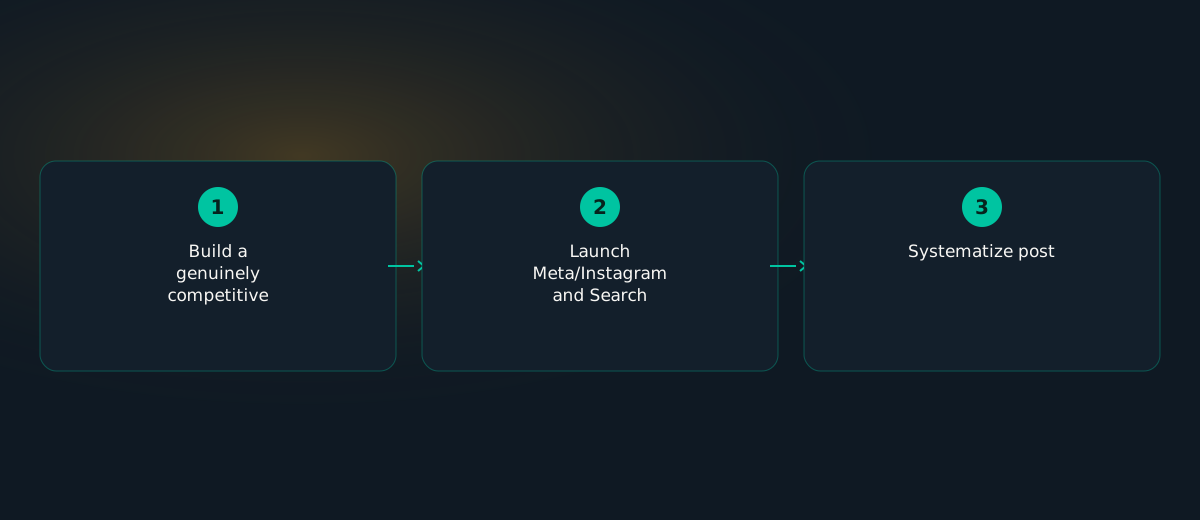
- Build a genuinely competitive direct-booking offer (rate guarantee, direct-only perks) before driving traffic to it.
- Invest in professional visual creative before scaling any paid channel — this category's creative quality bar is unusually high.
- Launch Meta/Instagram and Search together, retargeting OTA-referred visitors toward the direct site specifically.
- Systematize post-stay review requests as a defined process, not an occasional ask.
Budgets and Growth Roadmap
| Stage | Monthly budget | Focus |
|---|---|---|
| Starting out | $500-2,000 | Direct-booking offer built, Google Business Profile and reviews optimized |
| Established | $2,000-8,000 | Meta + Search running together, seasonal budget calendar planned |
| Multi-property or scaling | $8,000+ | Loyalty/repeat-guest program, retargeting systematized, dynamic seasonal reallocation |
Adjusting Budgets for Your Market
| Market | Consideration |
|---|---|
| India | Strong domestic leisure travel seasonality tied to school holidays and festival calendars; budget in ₹, plan around these specific windows |
| UAE/GCC | Significant inbound international tourism alongside domestic/regional travel; budget in AED and consider dual messaging for both audiences |
| International inbound marketing | Requires currency-appropriate pricing display and often multilingual creative, beyond what a purely domestic-focused campaign needs |
Why Visual Quality Matters More Here Than Most Categories
Hospitality and tourism are unusually visual, aspirational purchase categories — the image or video is a large part of the product actually being evaluated, not just supporting material for a functional claim the way it is in most other categories. Under-investing in professional photography and video, or relying on dated or low-quality visuals, directly and disproportionately suppresses performance in a way that's less true for more functionally-driven purchase categories.
Reviews as the Primary Trust Mechanism
A stay or tour experience can't be inspected before purchase the way a physical product can, making review volume, recency, and specific detail an outsized trust factor compared to lower-consideration categories. A property with excellent facilities but a stale or thin review base will often underperform a comparable property with a strong, current, detailed review presence — treat review generation as a core, ongoing marketing function, not an operational afterthought.
Guest Communication Operations, SOPs
Post-stay review request SOP:
1. Send within 24-48 hours of checkout, while the experience is fresh.
2. Make the ask specific and easy — a direct link, not a vague request.
3. Respond publicly to every review, positive and negative, within a few days.
CRM Workflow & Follow-Up Sequences
| Stage | Action | Timing |
|---|---|---|
| Site visit, no booking (from an OTA referral) | Retarget with a direct-booking incentive | Within days, before intent cools |
| Booking confirmed | Pre-arrival communication and upsell opportunity | 1-2 weeks before arrival |
| Post-checkout | Review request, loyalty program invitation | 24-48 hours after checkout |
| Past guest, off-peak period approaching | Value-focused re-engagement offer | Timed to the known seasonal calendar |
Mapping the Guest Journey
Need (a trip is being planned) → Research (destination and property search, often starting on an OTA or search engine) → Compare (photos, reviews, price across several properties) → Trust (review depth and recency, direct-site credibility) → Book (direct or OTA) → Experience (the actual stay) → Recommend (review, referral, repeat booking). The Compare and Trust stages are unusually visual and review-dependent compared to most categories in this cluster.
Sub-Category Variations
| Sub-category | Variation |
|---|---|
| Independent hotels/boutique properties | Direct-booking economics matter most here, given typically thinner margins than large chains |
| Tour operators/experiences | Reviews and visual content matter even more, since there's no physical property to inspect at all |
| Vacation rentals | Host responsiveness and review recency are especially decisive trust factors |
| Large chain/branded properties | Loyalty program integration often matters more than independent direct-booking incentives alone |
AI Implementation Roadmap
| Phase | What AI handles |
|---|---|
| 1 | Automated post-stay review requests, timed correctly |
| 2 | Retargeting OTA-referred visitors toward the direct booking site |
| 3 | Seasonal budget reallocation ahead of known demand shifts, not reactively |
| 4 | Creative variation generation to keep visual content fresh across a full seasonal calendar |
KPIs, Benchmarks & Dashboards
| KPI | Why it matters |
|---|---|
| Direct booking share of total revenue | The core profitability lever unique to this category |
| Review volume and average recency | A leading indicator of trust-driven conversion performance |
| Occupancy by season vs marketing spend by season | Confirms budget is actually flexing with demand rather than running flat |
| Repeat-guest rate | The direct-relationship payoff of loyalty and email marketing efforts |
Case Study
An independent boutique property sourced roughly three-quarters of its bookings through OTAs, with minimal direct marketing investment and no formal review-request process. Building a competitive direct-booking rate guarantee, launching Meta retargeting specifically toward OTA-referred site visitors, and systematizing post-stay review requests shifted a meaningful share of bookings to the direct channel within two quarters, improving overall margin at a similar occupancy rate — the commission saved on shifted bookings alone justified the marketing investment.
Decision Matrix
| Situation | Priority |
|---|---|
| Heavily OTA-dependent with thin margins | Build a direct-booking incentive and retargeting funnel before any other investment |
| Marketing spend runs flat year-round | Rebuild the budget calendar around the actual seasonal demand pattern |
| Thin or stale review base | Systematize the post-stay review request process before scaling paid spend further |
Common Mistakes
- Treating OTAs as the default channel rather than one option among several with a real margin cost.
- Running flat, unchanging marketing spend across peak and off-peak seasons.
- Under-investing in professional visual creative in a category where the image is a large part of the product.
- Leaving review generation to chance instead of a defined, systematic process.
Troubleshooting
Strong occupancy but thin margins: check OTA dependence — a high OTA-sourced booking share can quietly cap profitability even at good occupancy.
Direct site traffic isn't converting to bookings: check whether the direct-booking offer is genuinely competitive against what the same property shows on OTAs.
Launch Checklist
☐ Direct-booking rate guarantee or perk in place
☐ Retargeting set up for OTA-referred site visitors
☐ Professional visual creative current and seasonally refreshed
☐ Post-stay review request process systematized
☐ Marketing budget calendar planned around actual seasonal demand
AI Prompts to Speed This Up
- "Draft a direct-booking incentive offer and retargeting ad copy for guests who visited our site via an OTA referral but didn't book."
30/60/90-Day Plan
| Period | Focus |
|---|---|
| Days 1-30 | Build the direct-booking offer, audit visual creative quality, start systematic review requests |
| Days 31-60 | Launch Meta retargeting toward OTA-referred visitors, launch Search on booking-intent terms |
| Days 61-90 | Build the seasonal budget calendar for the year ahead, launch a loyalty/repeat-guest program |
FAQ
Why is OTA dependence a financial problem?
OTAs typically charge 15-25% commission per booking — shifting bookings direct keeps that margin.
How should seasonal demand be handled in marketing?
Plan budget and creative shifts ahead of the known seasonal calendar, not reactively.
Does visual quality matter as much as it seems to?
Yes — the image or video is genuinely a large part of the product being evaluated in this category.
How important are reviews here specifically?
Extremely — the experience can't be inspected before purchase, making reviews an outsized trust factor.
Most properties let OTA commission quietly eat margin instead of building a real direct-booking channel.
Zephra builds retargeting campaigns specifically for OTA-referred visitors, plans budget around your actual seasonal calendar, and systematizes review requests automatically — so direct bookings grow without a bigger marketing team.
Start Free Audit →Sources & Further Reading
- WordStream — 2026 Google Ads Benchmarks Report — Current cross-industry CPC, CTR, and conversion rate benchmarks.
OTA commission figures cited are general industry ranges — confirm current rates directly with specific OTA partners before calculating your own margin comparison.