The Complete Restaurant Growth Handbook
How restaurants actually fill tables and build repeat customers in 2026 — local discovery, reservation systems, loyalty, delivery-app economics, service consistency, AI workflows, and what to spend where.
Rohan Alexander · 30 min read · Updated July 2026
Quick Answer
Industry Overview & Economics
Restaurants run on thin margins and high fixed costs (rent, labor, food cost), which makes table-turn rate and repeat-visit frequency as important as new-customer acquisition. A restaurant that only acquires and never retains is fighting the hardest, most expensive version of this business.
| Metric | Typical range |
|---|---|
| Average check size, casual dining | $15 - $40 per cover |
| Typical food + labor cost | 55-65% of revenue |
| Repeat-visit rate, healthy | 30%+ of covers from repeat guests |
| Delivery-app commission | 15-30% of order value |
The Zephra Growth Flywheel™ for Restaurants
Each stage feeds the next — more reviews improve discoverability, which drives more visits, which produces more reviews. Restaurants that only invest in stage 1 end up paying repeatedly to reacquire the same type of first-time customer instead of building a returning base.
Why Restaurant Marketing Is Different
Dining decisions are unusually social-proof-driven and visual compared to most local services. Decisions are also frequently made in the moment rather than researched in advance, which makes local, real-time discoverability disproportionately important.
Marketing Maturity Model
| Stage | What's in place | Next investment |
|---|---|---|
| 1. Reactive | Word of mouth only, thin or outdated Google Business Profile | Fully complete Google Business Profile with current photos and menu |
| 2. Foundational | GBP complete, sporadic Instagram posting | Set a consistent posting schedule; launch review-request QR code |
| 3. Systematic | Reviews growing, no loyalty mechanism | Launch a simple loyalty program and guest CRM |
| 4. Optimized | Known repeat-visit rate, delivery margin tracked | Add occasion-based campaigns and direct-order channel |
| 5. Scaling | Predictable repeat-visit base, considering expansion | Multi-location profile management, brand-level campaigns |
Core Channels, Compared
| Channel | Best for | Notes |
|---|---|---|
| Google Business Profile / Maps | Local, in-the-moment discovery | Often the single highest-leverage free asset a restaurant has |
| Visual appeal, building return-visit intent | Food photography quality has an outsized effect on engagement | |
| Google Search Ads | Specific cuisine or occasion searches | Useful for reservations-driven or destination dining |
| Delivery apps | Off-premise/delivery order volume | Commission and placement fees can meaningfully compress margin |
| Email/SMS loyalty program | Repeat visits from the existing customer base | High-ROI, frequently under-invested in relative to acquisition spend |
Google Business Profile and Reviews
For "in-the-moment" dining searches, Google Business Profile completeness and review recency and volume are often the deciding factor between a restaurant that gets chosen and one that doesn't. A simple, consistent system for requesting reviews usually outperforms sporadic manual requests.
Delivery-App Economics
Delivery-app commissions plus optional paid placement fees can significantly compress margin on off-premise orders. It's worth calculating actual margin per delivery order before increasing paid placement spend, and building a direct-order channel reduces long-term platform dependency.
Step-by-Step Launch Guide
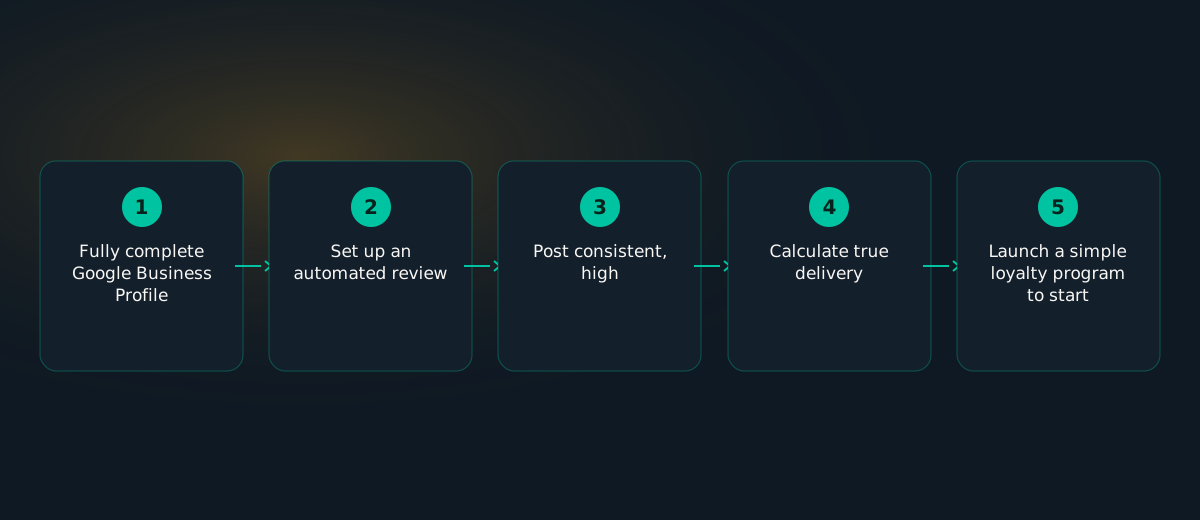
- Fully complete Google Business Profile — accurate hours, current menu, and real, recent photos.
- Set up an automated review-request system via receipt QR code or post-visit text.
- Post consistent, high-quality food photography to Instagram, 2-3 times a week.
- Calculate true delivery-app margin before increasing paid placement spend there.
- Launch a simple loyalty program to start building repeat-visit data.
- Consider Google Search ads only if reservations or destination dining is part of the model.
Realistic Budgets
| Stage | Monthly budget | Focus |
|---|---|---|
| Independent, single location | $500–$1,500 | Google Business Profile + Instagram + review system |
| Established, growing | $1,500–$3,500 | Add Google Search for reservations, formalize loyalty program |
| Multi-location | $3,500+ | Per-location profile management, brand-level campaigns |
Adjusting Budgets for Your Market
The figures above are illustrative starting points from a US-style market. Ad costs and average check size vary enough by country that the same restaurant stage can need a very different local budget — treat these as a rough starting multiplier and calibrate against actual local CPCs rather than converting currency 1:1.
| Market | Rough starting budget (independent, single location) | Notes |
|---|---|---|
| US / Western Europe | $500–$1,500/mo | Figures used elsewhere in this handbook |
| India | ₹12,000–₹35,000/mo | Lower average check size alongside lower CPCs generally keeps proportional economics similar |
| UAE / GCC | AED 2,500–6,500/mo | Higher average check size and a competitive dining market often justify a comparable or higher local budget |
Zephra's free audit calibrates budget recommendations against live local CPC data for your specific market rather than a fixed benchmark.
Loyalty and Repeat Visits
A simple loyalty mechanism is usually one of the highest-return investments available, yet many independent restaurants have none at all. The mechanism matters less than consistency — a simple system that's actually used outperforms an elaborate points program nobody remembers.
Food Photography and Creative
Photography quality has an outsized effect on both organic engagement and paid ad performance. Natural lighting and real portion sizes typically outperform heavily staged images, which can create a mismatch between expectation and reality that hurts reviews later.
Service Consistency SOPs
Peak-hour consistency check
1. Manager spot-check on plating and wait times every 30 minutes during peak service.
2. Table-side check-in within 5 minutes of food delivery for any party of 4+.
3. Any complaint escalated and resolved before the guest leaves, not after.
4. Post-shift log of any service issues for the next team huddle.
Guest CRM & Reservation Workflow
| Stage | Action | Timing |
|---|---|---|
| Reservation made | Confirmation sent | Immediately |
| Pre-visit reminder | SMS/email reminder | 24 hours before |
| Post-visit | Review request + loyalty points logged | Same day |
| Repeat guest | Occasion-based offer (birthday, anniversary) | As applicable |
| Lapsed guest | Win-back offer | At 60-90 days since last visit |
Restaurant-Type Variations
| Restaurant type | Primary emphasis |
|---|---|
| Casual / walk-in | Google Business Profile + Maps visibility, minimal paid ads needed |
| Reservation-driven / fine dining | Google Search + Instagram, occasion-based messaging |
| Delivery-heavy / cloud kitchen | Delivery-app optimization + direct-order channel |
| Multi-location chain | Consistent per-location Google Business Profile management + brand campaigns |
Staff and Consistency as a Marketing Lever
Service and food consistency function as a marketing channel in their own right, since a single inconsistent visit can undo months of review-building. Building simple consistency checks protects the review and reputation investment made elsewhere.
AI Implementation Roadmap
| Phase | Use case |
|---|---|
| Phase 1 | AI-drafted Instagram captions and review-response drafts |
| Phase 2 | AI-assisted reservation confirmation and reminder messaging |
| Phase 3 | AI-personalized loyalty offers based on past order history |
| Phase 4 | AI-assisted delivery-app margin tracking and placement-spend recommendations |
Seasonal and Occasion-Based Campaigns
Dining behavior shifts meaningfully around holidays, local events, and seasons, and restaurants that plan a simple content and offer calendar around these moments typically see a disproportionate lift compared to running identical, undifferentiated content year-round.
Case Study
An independent restaurant with a thin, outdated Google Business Profile and only 14 reviews was relying entirely on walk-in foot traffic. After fully completing the profile, launching a receipt QR-code review system, and posting food photography three times weekly, review count grew from 14 to 87 in twelve weeks, and direction requests roughly doubled — without any paid ad spend added.
Decision Matrix
| Situation | Priority |
|---|---|
| Weak or outdated Google Business Profile | Fix this before any paid spend |
| Good foot traffic but no repeat-visit system | Launch a simple loyalty mechanism before increasing acquisition spend |
| Heavy reliance on delivery apps with thin margins | Calculate true per-order margin and build a direct-order channel |
| Reservation-based or destination dining | Google Search ads and occasion-based Instagram content |
Common Mistakes
- Neglecting Google Business Profile completeness and accuracy in favor of paid ads alone.
- No systematic review-request process, leaving review growth to chance.
- Over-relying on delivery-app placement spend without checking true order-level margin.
- Inconsistent or low-quality food photography that undersells the actual dining experience.
- No loyalty or repeat-visit system despite steady new-customer acquisition spend.
- No consistency checks during peak service, letting preventable bad visits generate the reviews that are hardest to recover from.
Troubleshooting
Good reviews but declining foot traffic: check Google Business Profile accuracy — even a strong review base won't help if listed hours or menu are outdated.
Delivery orders growing but profit not improving: recalculate true margin per delivery order after commission and placement fees.
Instagram engagement low despite consistent posting: check photography quality and posting consistency together.
Launch Checklist
☐ Google Business Profile fully complete and current
☐ Automated review-request system in place
☐ Consistent Instagram posting schedule (2-3x/week minimum)
☐ True delivery-app margin calculated
☐ Simple loyalty mechanism launched
☐ Peak-hour consistency checks in place
☐ Reservation or occasion-based ads considered only if relevant to the model
AI Prompts to Speed This Up
- "Write 3 Instagram captions for a [cuisine type] restaurant post featuring [dish], each with a different tone."
- "Draft a simple loyalty program structure for a casual restaurant with an average check size of [$X]."
- "Write a 60-day win-back SMS for a guest who hasn't visited recently, offering a modest incentive without sounding desperate."
30/60/90-Day Plan
| Period | Focus |
|---|---|
| Days 1-30 | Fully complete Google Business Profile, set up review-request QR code, start consistent Instagram posting. |
| Days 31-60 | Audit delivery-app margins, launch a simple loyalty program, add peak-hour consistency checks. |
| Days 61-90 | Review growth in reviews, direction requests, and repeat-visit rate; plan first occasion-based campaign. |
FAQ
What's the most effective marketing channel for a restaurant?
Google Business Profile and Maps visibility for discovery, with Instagram driving awareness and repeat-visit intent.
Should restaurants pay for premium placement on delivery apps?
Depends on margins — calculate true profit per delivery order first, and build a direct-order channel to reduce platform dependency.
How important are reviews for restaurant marketing?
Very — review volume, recency, and rating are often the deciding factor between similarly-located restaurants.
What's a realistic marketing budget for a restaurant?
Many independents start around $500-$1,500/month, with the biggest early lift often from free levers like Google Business Profile and reviews.
How much does one inconsistent visit actually cost a restaurant?
Often more than a marketing campaign is worth — negative reviews are far harder to offset than to prevent through basic consistency checks.
You can build a reservations-and-repeat-visit system manually using the steps above.
Zephra manages Google Business Profile optimization, automated review requests, and loyalty-focused retargeting from one dashboard, so the discovery-to-return loop compounds without manual coordination across tools.
Start Free Audit →Sources & Further Reading
- WordStream — 2026 Google Ads Benchmarks Report — Current cross-industry CPC, CTR, conversion rate, and cost-per-lead benchmarks.
- Google Ads Help — How our bidding algorithms learn — Google's guidance on how its bidding algorithms learn from account data.
Figures and platform mechanics referenced in this guide are cross-checked against the above as of publication; confirm current figures directly with the source before making budget decisions.