Quick Answer
School and preschool admissions marketing succeeds by aligning with the parent research timeline — starting awareness campaigns 6-9 months before applications open, using open houses as the key conversion moment, and treating parent referrals as the highest-trust channel worth actively cultivating. Most institutions market reactively, close to the application deadline, missing the much longer window during which parents actually form their shortlist.
Industry Overview & Economics
School admissions economics are defined by a fixed annual intake capacity and an unusually long, trust-heavy decision cycle. Unlike most businesses in this guide, a school can't simply "sell more" mid-year — every admissions cycle has one real shot per grade cohort, which raises the cost of a missed early-awareness window.
| Metric | Typical range |
|---|
| Family lifetime value (multi-year enrollment) | Several years of tuition — often 5-15x a single year's value |
| Typical research window before application | 6-9 months |
| Target cost per qualified inquiry | $20 - $100 depending on institution type |
| Open-house-to-application conversion, healthy | 25-40% |
The Zephra Marketing Operating System™ for Schools
PHASE 1
Awareness (6-9 months out)
PHASE 2
Consideration & open houses (3-6 months out)
PHASE 3
Application & decision (0-3 months out)
Most schools concentrate all their marketing effort in Phase 3, once applications are already open — by which point many families have already narrowed their shortlist based on Phase 1 and 2 research they did with little or no marketing from the school reaching them at all.
Why School Marketing Is Different
Choosing a school is a high-stakes, infrequent, deeply trust-dependent decision that parents research over months, not days. Parents weigh intangible factors that are difficult to convey through ads alone, which is why in-person or live-virtual touchpoints tend to matter more here than in almost any other vertical in this guide.
Understanding the Admissions Cycle
Parents researching a school for the following academic year typically begin looking 6-9 months before the application window opens. Mapping marketing activity backward from the application deadline, rather than starting only when it opens, is the single biggest structural fix available to most institutions.
Marketing Maturity Model
| Stage | What's in place | Next investment |
|---|
| 1. Reactive | Marketing starts only when applications open | Map a 6-9 month calendar backward from the deadline |
| 2. Foundational | Awareness calendar exists, open houses under-promoted | Promote open houses 2+ months ahead with simple registration |
| 3. Systematic | Open houses well-attended, follow-up inconsistent | Build a defined post-visit follow-up process with a response-time target |
| 4. Optimized | Known inquiry-to-application conversion rate | Formalize parent referral program and sibling retention process |
| 5. Scaling | Predictable enrollment pipeline year over year | Multi-campus rollout of the proven admissions calendar |
Core Channels, Compared
| Channel | Best for | Notes |
|---|
| Parent referrals | Highest-trust inquiries | Often the deciding factor for risk-averse parents; deserves active cultivation |
| Meta ads | Open-house and info-session promotion | Effective for driving the key in-person conversion moment |
| Google Business Profile / reviews | Research-stage credibility | Genuine, recent parent reviews carry significant weight |
| School website / virtual tour content | Early research-stage evaluation | Should answer curriculum, philosophy, and practical questions clearly |
Open Houses and Info Sessions
For most families, an in-person or live-virtual visit is the deciding moment after initial online research. Promoting open houses well in advance, making registration simple, and following up promptly typically converts meaningfully better than treating the event as passive.
Parent Referral Networks
Because school choice carries such high perceived stakes, a trusted recommendation from another parent often carries more weight than any advertising a school could produce. Actively cultivating parent referrals is one of the highest-value activities available.
Step-by-Step Launch Guide
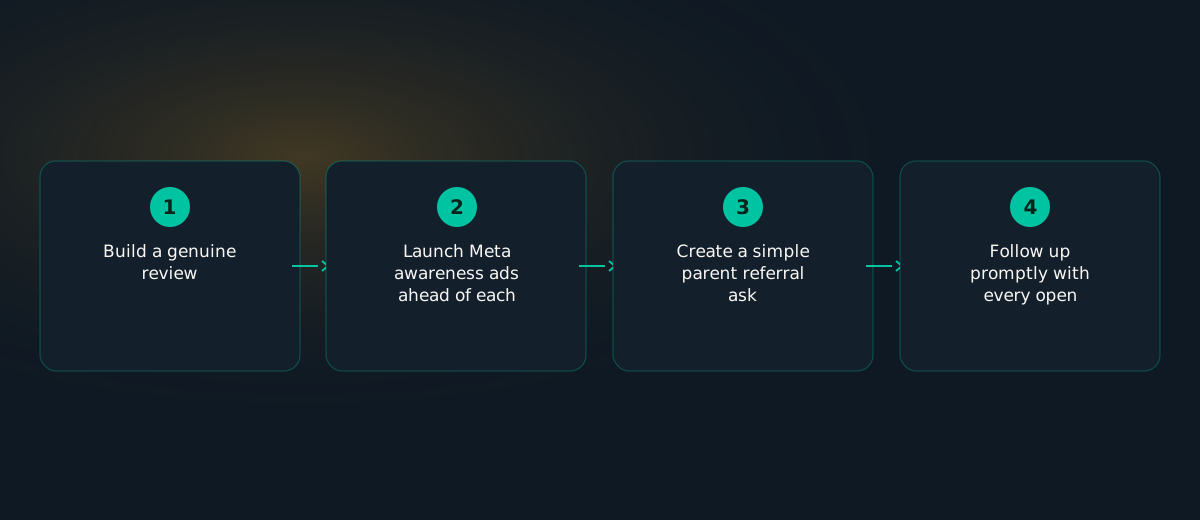
- Map your marketing calendar backward from the application deadline, starting awareness activity 6-9 months ahead.
- Schedule and promote open houses early, with simple online registration.
- Build a genuine review-request habit among current, satisfied parents.
- Launch Meta awareness ads ahead of each open house.
- Create a simple parent referral ask.
- Follow up promptly with every open-house attendee within 48 hours.
Realistic Budgets
| Institution size | Monthly budget (peak season) | Focus |
|---|
| Independent preschool / small school | $1,000–$2,000 | Open-house promotion + parent referral cultivation |
| Established school, multiple grade levels | $2,000–$5,000 | Earlier-phase awareness campaigns + review-building |
| Multi-campus institution | $5,000+ | Per-campus admissions campaigns and dedicated content |
Budget is best concentrated in the months leading up to open houses and application deadlines rather than spread evenly year-round.
Adjusting Budgets for Your Market
The figures above are illustrative starting points from a US-style market. Tuition levels and ad costs vary enough by country that the same institution size can need a very different local budget — treat these as a rough starting multiplier and calibrate against actual local CPCs rather than converting currency 1:1.
| Market | Rough starting budget, peak season (independent preschool/small school) | Notes |
|---|
| US / Western Europe | $1,000–$2,000/mo | Figures used elsewhere in this handbook |
| India | ₹25,000–₹50,000/mo | Wide range depending on whether the institution is budget, mid-tier, or premium international |
| UAE / GCC | AED 5,000–10,000/mo | Higher tuition levels at many private and international schools often justify a comparable or higher local budget |
Zephra's free audit calibrates budget recommendations against live local CPC data for your specific market rather than a fixed benchmark.
Content That Builds Parent Trust
Content answering the specific, practical questions parents are actually weighing builds more trust than promotional brand messaging. Video featuring real teachers and current students tends to outperform polished but generic material.
Admissions Operations & SOPs
Open-house follow-up SOP
1. Send a thank-you and next-steps email within 24 hours of attendance.
2. Personal call or message from admissions staff within 48 hours for serious inquiries.
3. Application deadline reminder at defined intervals (30, 14, 7 days out).
4. Log every touchpoint and response in the CRM.
Enrollment CRM & Follow-Up Workflow
| Stage | Action | Timing |
|---|
| Inquiry logged | Source + grade level tagged | Immediately |
| Open house registered | Confirmation + reminder sent | Immediately, then 48/24 hrs before |
| Attended | Thank-you + next steps | Within 24 hours |
| Considering | Personal follow-up + deadline reminders | Day 2, then at 30/14/7 days to deadline |
| Enrolled | Welcome sequence + referral ask | At enrollment confirmation |
Institution-Type Variations
| Institution type | Primary emphasis |
|---|
| Preschool / early years | Parent referrals + safety and caregiver-quality messaging |
| K-12 independent school | Open houses + long-lead awareness campaigns |
| Coaching institute / test prep | Results-focused content + shorter decision cycle around exam calendars |
| Higher-ed / specialized program | Outcome and placement data + longer nurture sequence |
Digital Presence for the Research Phase
Long before a family visits in person, they typically evaluate a school's website, reviews, and social presence. A thin or outdated digital presence at this stage can lose a family that would have loved the school in person but never got that far.
AI Implementation Roadmap
| Phase | Use case |
|---|
| Phase 1 | AI-drafted open-house ad copy and parent FAQ content |
| Phase 2 | AI-assisted CRM logging of inquiry source and grade level |
| Phase 3 | AI-personalized deadline reminder sequences by application stage |
| Phase 4 | AI-assisted sibling and alumni outreach at the right calendar moments |
Sibling and Alumni Retention
For schools with multiple grade levels, retaining existing families for sibling enrollment and maintaining alumni relationships is typically far less expensive than acquiring entirely new families, yet is often left to informal goodwill rather than a deliberate process.
Case Study
A K-12 independent school that began marketing only when its application window opened was seeing declining inquiry volume year over year. Shifting to a 9-month calendar with early awareness content, two well-promoted open houses, and a parent referral ask grew qualified inquiries by roughly 60% year-over-year.
Decision Matrix
| Situation | Priority |
|---|
| Marketing only starts when applications open | Build a 6-9 month backward-mapped calendar starting with awareness |
| Good inquiry volume, low open-house attendance | Review promotion timing and registration friction |
| Good attendance, low application conversion | Improve post-visit follow-up speed and clarity on next steps |
| Strong reputation, informal referral activity | Formalize a simple, low-friction parent referral process |
Common Mistakes
- Starting marketing only when the formal application window opens.
- Promoting open houses only a week or two in advance.
- Slow or inconsistent follow-up after open-house attendance.
- Leaving parent referrals entirely informal instead of actively cultivating them.
- Using vague, promotional messaging instead of answering parents' specific practical questions.
- No deliberate sibling or alumni retention process.
Troubleshooting
Good website traffic, few open-house registrations: check how far in advance open houses are promoted and how simple registration is.
Good open-house attendance, low application follow-through: check post-visit follow-up speed and clarity.
Inquiry volume declining year over year: check whether awareness activity is starting early enough.
Launch Checklist
☐ Marketing calendar mapped backward from application deadline
☐ Open houses scheduled and promoted 2+ months ahead
☐ Simple online open-house registration in place
☐ Parent review-request habit established
☐ Referral ask built into open-house promotion
☐ Post-visit follow-up process defined with a clear response-time target
☐ Sibling/alumni retention process documented
AI Prompts to Speed This Up
- "Write a Meta ad promoting an upcoming school open house, targeted at parents of children aged [X], focused on curiosity rather than urgency."
- "Draft a parent FAQ page answering the 8 most common practical questions about [curriculum/safety/logistics] for a school website."
- "Write a sibling-enrollment reminder email ahead of the upcoming application window."
30/60/90-Day Plan
| Period | Focus |
|---|
| Days 1-30 | Map the admissions calendar backward from the deadline; schedule and begin promoting the next open house. |
| Days 31-60 | Set up parent review requests and a referral ask; define the post-visit follow-up process. |
| Days 61-90 | Review inquiry-to-application conversion; formalize sibling and alumni retention outreach. |
FAQ
When should a school start its admissions marketing campaign?
Well before the application window opens — many parents begin researching 6-9 months ahead of the following academic year.
What's the most effective channel for school admissions marketing?
Parent referrals for trust, supported by Meta ads for open-house promotion and a strong Google Business Profile for research-stage credibility.
How important are open houses and info sessions?
Very — for most families, this is the deciding moment where intangible factors that ads can't convey get evaluated directly.
What's a realistic marketing budget for an independent school?
Many budget $1,000-$3,000/month, concentrated in the months before open houses and application deadlines.
How much does sibling retention matter compared to new-family acquisition?
It's typically far less expensive than acquiring new families, though often left informal rather than managed deliberately.
HOW ZEPHRA HELPS
You can build this calendar manually using the steps above.
Zephra plans and paces admissions campaigns against your actual application deadline, timing awareness and open-house promotion automatically rather than leaving it to reactive, last-minute marketing once applications open.
Start Free Audit →
Sources & Further Reading
Figures and platform mechanics referenced in this guide are cross-checked against the above as of publication; confirm current figures directly with the source before making budget decisions.