How to Get More Customers for Your Business
Getting more customers is rarely about one tactic. It's about building a repeatable system — attract, capture, nurture, convert, retain, refer — and fixing the weakest link in that chain before spending more on marketing.
Rohan Alexander · 10 min read · Updated July 2026
Executive Summary
Businesses grow when they consistently attract the right audience, convert visitors into leads, nurture trust, close sales, and retain customers. This guide walks through a practical customer acquisition system that combines positioning, marketing, advertising, referrals, and customer experience — instead of chasing every channel at once. It also covers which channel to start with depending on your business type, how to scale past your first one, how this looks different for B2B versus local service versus ecommerce businesses, and where this typically goes wrong.
Quick Action Checklist
- Define your ideal customer profile.
- Write a clear, one-sentence value proposition.
- Make sure your website has a strong, specific call to action.
- Set up analytics and conversion tracking before you spend on ads.
- Choose one primary acquisition channel to start.
- Build a follow-up process for every single lead.
- Track Cost per Lead, Conversion Rate, and Customer Acquisition Cost from day one.
The Zephra Customer Acquisition Framework™
Every durable acquisition system moves a stranger through six stages. Most "we're not getting customers" problems trace back to a weak stage, not a missing channel.
| Stage | Goal | Examples |
|---|---|---|
| Attract | Generate awareness | SEO, Google Ads, Meta Ads, referrals, content |
| Capture | Convert visitors to leads | Landing pages, forms, chat |
| Nurture | Build trust | Email, CRM, remarketing |
| Convert | Close the sale | Sales calls, demos, offers |
| Retain | Increase lifetime value | Support, loyalty, upsell |
| Refer | Create advocates | Referral programs, reviews |
Use this as a diagnostic, not just a diagram: if leads are drying up, check Attract and Capture first. If leads come in but sales don't close, the problem usually sits in Nurture or Convert. If customers buy once and disappear, it's Retain and Refer that need work. Most businesses over-invest in Attract because it's the most visible stage — the ad you ran, the post you boosted — while the cheaper, higher-leverage fixes usually sit downstream in Capture and Nurture.
Why Most Businesses Struggle to Get Customers
- No clear positioning — the offer doesn't say who it's for or why it's different, so every dollar of traffic has to work harder to earn attention.
- Weak or confusing messaging on the homepage, often written from the business's point of view ("we've been in business 20 years") rather than the customer's ("get your leak fixed today").
- Poor website conversion — traffic arrives, but the page doesn't ask for anything clearly, or asks for too much too soon.
- No consistent lead generation — marketing runs in bursts around cash flow rather than as an always-on system, so momentum never compounds.
- No follow-up process — leads come in and go cold because nobody owns the response.
- Marketing decisions based on assumptions rather than data, because tracking was never set up to begin with.
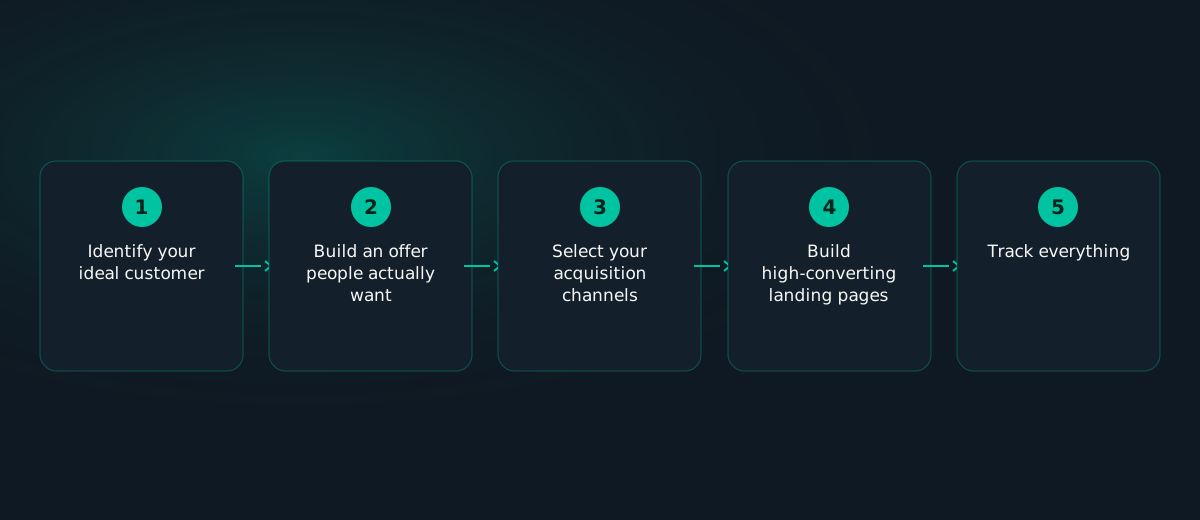
Step-by-Step Customer Growth Plan
1. Identify your ideal customer
Document industry, company size, geography, budget, pain points, buying triggers, objections, and who actually makes the decision to buy. Be specific enough that you could describe a real person, not a demographic bracket — "a homeowner who just noticed a wet patch on the ceiling" is more useful than "homeowners aged 35-55."
2. Build an offer people actually want
Your offer should solve one clear problem with a measurable outcome — not a general description of your services. "Same-day leak repair, upfront pricing" outperforms "residential and commercial plumbing services" because it answers the two questions every visitor is silently asking: can you solve my specific problem, and how fast.
3. Select your acquisition channels
- Search intent → Google Search Ads
- Demand generation → Meta Ads
- Long-term compounding growth → SEO
- B2B → LinkedIn and partnerships
- Existing customers → Referral programs
4. Build high-converting landing pages
Every campaign should send visitors to a dedicated page that matches the ad's promise — not your homepage. A homepage tries to serve every visitor at once; a matched landing page serves exactly the person who clicked that specific ad, with exactly the offer they were promised.
5. Track everything
Install analytics, conversion tracking, and CRM integrations before spending on advertising, not after. Retroactively fixing tracking means you've already spent money you can't learn from.
Recommended Acquisition Channels
| Channel | Speed | Cost | Best For |
|---|---|---|---|
| Google Ads | Fast | Medium–High | High-intent buyers |
| Meta Ads | Fast | Medium | Awareness and ecommerce |
| SEO | Slow | Medium | Long-term growth |
| Medium | Low | Nurturing leads | |
| Referrals | Medium | Low | Trust and retention |
Decision Matrix: Which Channel Should You Start With?
| Your situation | Start here | Why |
|---|---|---|
| Customers actively search for what you sell | Google Search Ads | Captures existing demand, easiest to measure |
| Visually appealing product, low urgency purchase | Meta / Instagram Ads | Creates demand through discovery, not search |
| High-ticket, trust-dependent service | Referrals + Google Ads | Referrals pre-qualify trust; ads add volume |
| Long B2B sales cycle | LinkedIn + SEO | Matches how B2B buyers research over weeks/months |
| Very limited budget (under $500/mo) | Google Business Profile + referrals | Lowest cost, works before paid volume makes sense |
Industry Variations
The six-stage framework holds across business types, but where the weak link tends to sit differs:
| Business type | Usually weakest stage | What to prioritize |
|---|---|---|
| B2B / long sales cycle | Nurture | Email sequences, retargeting, sales enablement content |
| Local service business | Attract + Refer | Google Business Profile, reviews, local Search Ads |
| Ecommerce / DTC | Capture + Retain | Landing page conversion rate, post-purchase email flows |
| High-ticket professional services | Convert | Sales process, proposal quality, objection handling |
Advanced: Scaling Past Your First Channel
Once one channel produces a predictable, profitable cost per customer, resist the urge to immediately diversify. Instead:
- Scale the working channel first — increase budget in increments of 20-30%, watching whether cost per lead holds steady.
- Add retargeting before adding a second acquisition channel — it's cheaper and captures people who already showed interest.
- Layer in a second channel only once the first is stable, so you can isolate what's driving any change in results.
- Build a lookalike or similar-audience strategy from your best existing customers once you have enough conversion data (typically 50-100+ conversions).
- Formalize retention and referral — at scale, acquiring from existing customers is consistently cheaper than acquiring new ones.
A useful discipline at this stage: change one variable at a time. Businesses that scale budget, add a new channel, and refresh creative all in the same week lose the ability to tell which change actually moved the number.
Case Study: Fixing the Funnel Before Adding Spend
A regional home-services business came to this exact problem: steady website traffic from Google Ads, but a conversion rate under 1%. Instead of increasing budget, the fix started at the Capture stage — the homepage was the ad's landing destination, with six competing calls to action and no phone number above the fold.
The change: a single dedicated landing page per campaign, matched to the ad's specific offer, with one clear call to action and a callback-request form requiring only name and phone number. Conversion rate moved from under 1% to just over 4% within three weeks, at the same ad spend — the acquisition problem had never been a traffic problem. The business then used the extra lead volume to justify a modest budget increase, and cost per customer actually fell slightly further as the campaign's Quality Score improved alongside the better-matched landing page.
Pros and Cons of Building This Manually
| Pros | Cons | |
|---|---|---|
| Manual / DIY | Full control, no software cost, deep understanding of your own funnel | Time-intensive, steep learning curve, easy to miss tracking setup |
| Freelancer / agency | Expertise without hiring, less time from you | Ongoing cost, less direct visibility into daily decisions |
| AI marketing platform | Speed, lower cost than an agency, daily optimization built in | Less bespoke than a dedicated strategist for very complex accounts |
Common Mistakes
- Running ads without tracking.
- Trying every marketing channel simultaneously.
- Ignoring existing customers.
- Not following up with leads.
- Sending paid traffic to the homepage.
- Stopping campaigns too early.
Troubleshooting
Symptom: traffic is steady but conversions are flat. Diagnosis: usually a Capture-stage problem — check landing page match and form friction before touching the ad itself.
Symptom: leads come in but few close. Diagnosis: usually a Nurture or Convert problem — check response time and whether leads are actually qualified before reaching sales.
Symptom: cost per lead climbing over time. Diagnosis: often audience saturation — refresh creative, expand targeting, or add a new channel rather than pushing more budget into the same narrow audience.
Symptom: strong first month, declining second month. Diagnosis: check whether early results relied on a warm existing audience (email list, retargeting pool) that thinned out once genuinely new customers replaced it.
Copyable Acquisition Plan Template
Ideal customer: ____________________
One-sentence value proposition: ____________________
Primary channel (this quarter): ____________________
Landing page URL for this channel: ____________________
Monthly budget: ____________________
Target cost per lead: ____________________
Follow-up process (who, how fast): ____________________
Weekly review day: ____________________
AI Prompts to Speed This Up
- "Write a one-sentence value proposition for a [type of business] that serves [ideal customer] and solves [specific problem]."
- "List 10 negative keywords I should exclude from a Google Ads campaign for [industry]."
- "Draft 3 headline variations for a landing page promoting [offer] to [ideal customer]."
- "Suggest a simple follow-up email sequence for a new lead who requested [offer] but hasn't responded in 48 hours."
30-Day Action Plan
| Week | Focus |
|---|---|
| 1 | Research your ideal customer and competitors. |
| 2 | Improve your website and build a matched landing page. |
| 3 | Launch one acquisition channel. |
| 4 | Review metrics, optimize, and document what you learned. |
FAQ
What is the fastest way to get more customers?
For most businesses, it's a paid channel matched to a dedicated, high-converting landing page with tracking already in place — Google Ads for high-intent search demand, or Meta Ads for awareness and ecommerce. Speed without tracking just hides whether it actually worked.
How much should a small business spend to get more customers?
There's no universal number — it depends on your average order value and target Customer Acquisition Cost. As a starting rule, keep your CAC well under your customer's lifetime value, and budget enough to gather at least 20–30 conversions per month per channel before judging performance.
Why do most small businesses struggle to get customers?
Usually a combination of unclear positioning, weak website conversion, inconsistent lead generation, and no follow-up process — not a lack of marketing channels.
Should I focus on one marketing channel or several?
Start with one channel matched to your customer's buying intent, get it profitable, then add a second. Running several channels before any of them work reliably makes it much harder to tell what's actually driving results.
How long before a new acquisition channel starts working?
Paid channels can show early signal within 1-2 weeks; a defensible read on performance usually needs 4-6 weeks and enough volume to judge cost per lead with confidence. Organic channels like SEO and referrals typically take 3-6 months to compound.
Does this framework change for B2B vs local service vs ecommerce businesses?
The six stages stay the same, but which stage needs the most attention differs. B2B sales cycles usually need more Nurture; local services lean on Attract and Refer through reviews; ecommerce lives or dies on Capture-stage conversion rate and Retain-stage repeat purchase.
What's a realistic timeline to see if this system is working?
Give the full system 90 days before judging it — roughly 30 days fixing foundations, 30 gathering trustworthy data, and 30 optimizing based on what that data shows.
You can run this whole process manually.
Spreadsheets, a few tools, and regular analysis will get you there. Zephra AI is built to streamline the same workflow — audience research, keyword discovery, campaign planning, ad copy generation, budget recommendations, landing page suggestions, and performance monitoring — across Google and Meta from one place. It complements sound marketing practice; it doesn't replace it.
Start Free Audit →Sources & Further Reading
- Harvard Business Review — The Value of Keeping the Right Customers — Frederick Reichheld's (Bain & Company) research on retention's effect on profit, published in HBR.
- WordStream — 2026 Google Ads Benchmarks Report — Current cross-industry CPC, CTR, conversion rate, and cost-per-lead benchmarks.
- Baymard Institute — 50 Cart Abandonment Rate Statistics — A meta-analysis of 50 independent studies on cart abandonment rates and causes.
Figures and platform mechanics referenced in this guide are cross-checked against the above as of publication; ad platform thresholds and benchmarks change over time, so confirm current figures directly with the source before making budget decisions.