The Complete Contractor Growth Handbook
Emergency jobs and planned projects are two different businesses wearing the same license — the full system for marketing both, dispatching well, and building a referral engine on top.
Rohan Alexander · 28 min read · Updated July 2026
Quick Answer
Industry Overview & Economics
Contractor economics are capacity-bound like a clinic's, but with the added variable of crew scheduling and job duration. A single-crew business can only complete so many jobs per week regardless of lead volume, so marketing spend should be sized against realistic scheduling capacity, not ambition.
| Metric | Typical range |
|---|---|
| Average ticket, emergency service call | $150 - $600 |
| Average ticket, planned renovation project | $3,000 - $30,000+ |
| Target cost per lead, emergency | $30 - $80 |
| Target cost per lead, planned project | $50 - $200 |
The Zephra Marketing Operating System™ for Contractors
| Job type | Conversion goal | What "good" looks like |
|---|---|---|
| Emergency | Phone call, answered live | Under 5-minute response time, dispatch confirmed same day |
| Planned project | Quote request form or scheduled estimate visit | Detailed follow-up within 24 hours, itemized quote within a week |
Blending these into a single ad group and landing page dilutes both — an emergency searcher wants a phone number immediately, and a planned-project searcher wants proof of quality before ever calling.
Why Contractor Marketing Is Different
Unlike most local services, contractor demand is split between near-zero-consideration emergencies and long-consideration, high-ticket planned projects — sometimes within the same trade. Trust matters disproportionately more than in most categories because the work is expensive, hard to reverse, and happens inside someone's home.
Marketing Maturity Model
| Stage | What's in place | Next investment |
|---|---|---|
| 1. Reactive | Word of mouth only, no tracked leads | Segment job types, start Local Services Ads verification |
| 2. Foundational | One blended campaign, no call tracking | Split emergency/planned-project campaigns and landing pages |
| 3. Systematic | Split campaigns live, call tracking installed | Build before/after photo library, add dispatch SOPs |
| 4. Optimized | Known cost per lead by job type | Add CRM quote-follow-up workflow and referral program |
| 5. Scaling | Predictable lead flow matched to crew capacity | Add a second crew or trade line with the proven structure |
Job-Type Segmentation
| Job type | Keyword example | Approach |
|---|---|---|
| Emergency | "burst pipe repair," "no heat emergency," "AC not working today" | Higher bid, same-day/24-7 messaging, call tracking as the priority metric |
| Planned project | "kitchen remodel cost," "roof replacement," "bathroom renovation" | Lower bid, longer-form landing page, before/after gallery, quote-request form |
Core Channels, Compared
| Channel | Best for | Notes |
|---|---|---|
| Google Local Services Ads | Emergency and licensed-trade lead capture | Pay-per-lead, Google-verified badge, strong trust signal |
| Google Search Ads | Both job types, more control over messaging | Requires message-matched landing pages per job type |
| Google Business Profile | Local discovery and review-driven trust | Free, high-leverage, especially for planned-project research |
| Facebook/Instagram | Before/after visual proof, planned-project awareness | Weaker for true emergencies; strong for renovation-type work |
| Referral / repeat customer outreach | Planned projects, especially larger renovations | Often the highest-margin lead source, most under-invested in |
Google Local Services Ads
Local Services Ads (LSAs) show a Google-verified badge and charge per qualified lead rather than per click, which tends to produce a more predictable cost per lead than standard Search campaigns for many home-service categories. Getting Google-verified takes time to set up but is worth doing early, since the badge itself is a meaningful trust signal independent of the ad copy.
Licensing, Insurance, and Trust Signals
| Trust signal | Impact |
|---|---|
| License number displayed | Baseline expectation; its absence is a red flag for cautious homeowners |
| Insurance/bonding stated clearly | Reduces hesitation meaningfully for larger, higher-risk projects |
| Before/after photos | Strongest trust signal for visually verifiable work |
| Google-verified badge (via LSA) | Adds third-party credibility beyond self-reported claims |
| Reviews mentioning specific job types | More persuasive than generic star ratings alone |
Step-by-Step Launch Guide
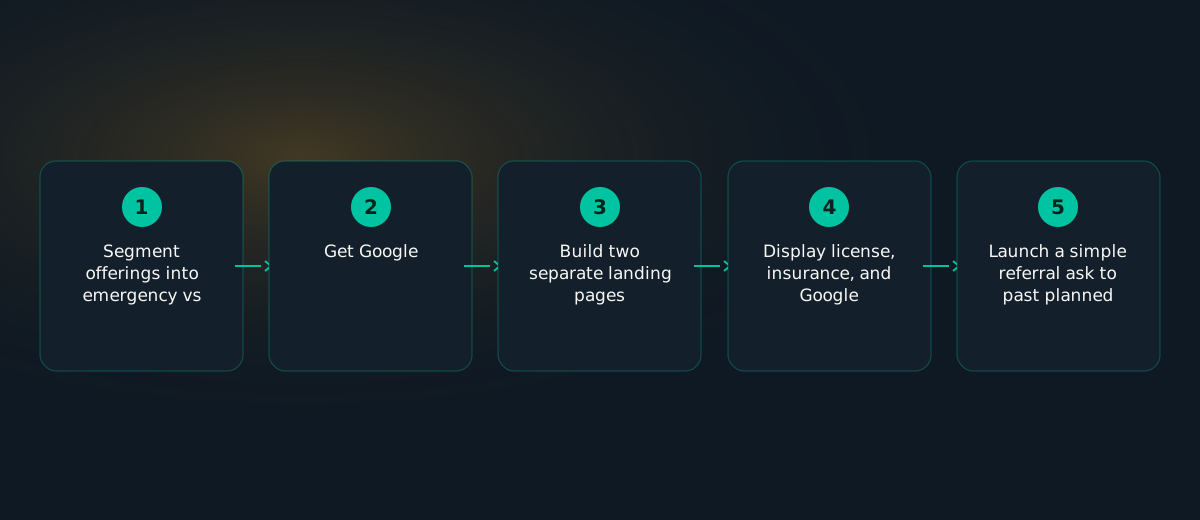
- Segment offerings into emergency vs planned-project job types before building any campaign.
- Get Google-verified for Local Services Ads — start this early since verification takes time.
- Build two separate landing pages — a fast, phone-first page for emergency jobs, and a longer-form quote-request page for planned projects.
- Set up call tracking as the priority conversion metric for emergency campaigns.
- Display license, insurance, and Google-verified badge prominently.
- Launch a simple referral ask to past planned-project customers.
Realistic Budgets by Trade
| Trade type | Monthly budget | Focus |
|---|---|---|
| Single-crew (plumber, electrician, HVAC) | $1,000–$3,000 | Local Services Ads + Google Business Profile |
| Renovation / remodeling | $2,000–$5,000 | Search + Instagram before/after content, longer sales cycle |
| Multi-crew / larger operation | $5,000+ | Full-funnel: LSA, Search, referral program, brand awareness |
Spending beyond what your crew can realistically schedule just creates a backlog and hurts response-time reputation.
Adjusting Budgets for Your Market
The figures above are illustrative starting points from a US-style market. Ad costs, labor costs, and average ticket size vary enough by country that the same trade can need a very different local budget — treat these as a rough starting multiplier and calibrate against actual local CPCs rather than converting currency 1:1.
| Market | Rough starting budget (single-crew trade) | Notes |
|---|---|---|
| US / Western Europe | $1,000–$3,000/mo | Figures used elsewhere in this handbook |
| India | ₹20,000–₹60,000/mo | Lower average ticket size alongside lower CPCs generally keeps proportional economics similar |
| UAE / GCC | AED 4,000–11,000/mo | Often comparable to US CPCs for licensed trades in a competitive, high-cost-of-living market |
Zephra's free audit calibrates budget recommendations against live local CPC data for your specific market rather than a fixed benchmark.
Seasonality and Demand Planning
Most trades have a predictable seasonal pattern — HVAC demand spikes ahead of summer and winter extremes, roofing after storm seasons, landscaping in spring. Planning budget increases ahead of these known windows, rather than reacting once demand has already spiked, typically produces a lower cost per lead.
Dispatch Operations & SOPs
Emergency dispatch SOP
1. Answer within 3 rings, 24/7 for true emergency lines.
2. Confirm address, issue, and access details before ending call.
3. Dispatch nearest available crew; confirm arrival window with the customer.
4. Text confirmation with technician name and ETA.
Planned-project quote SOP
1. Schedule an on-site estimate within 48 hours of inquiry.
2. Send an itemized quote within 5-7 business days.
3. Follow up if no response within 5 days of quote delivery.
4. Log outcome (won/lost, and why) in the CRM for every quote.
CRM & Quote Follow-Up Workflow
| Stage | Action | Timing |
|---|---|---|
| Lead logged | Job type + trade tagged | Immediately |
| Contacted | Call/dispatch or estimate scheduled | Within 5 min (emergency) / 48 hrs (planned) |
| Quoted | Itemized quote sent | Within 5-7 days |
| Awaiting decision | Follow-up call/message | Day 5, day 10 |
| Won | Job scheduled, referral ask set for completion | At project close |
Trade-Type Variations
| Trade | Primary emphasis |
|---|---|
| Plumbing / HVAC / electrical | Emergency-first, Local Services Ads, call tracking |
| Roofing | Storm-season surge planning, before/after and drone photography |
| Renovation / remodeling | Portfolio-driven Instagram/Search, longer quote-to-close cycle |
| Landscaping | Seasonal campaigns, recurring-service retention |
AI Implementation Roadmap
| Phase | Use case |
|---|---|
| Phase 1 | AI-drafted emergency and planned-project ad copy variations |
| Phase 2 | AI-assisted itemized quote drafting from a technician's on-site notes |
| Phase 3 | AI-driven quote follow-up reminders and win/loss logging |
| Phase 4 | AI-assisted dispatch routing based on crew location and job type |
Case Study
A residential plumbing business was running one blended Search campaign mixing emergency and planned-project keywords, sending all traffic to a single general homepage. Cost per lead sat above $85 with a low form-completion rate. After splitting into two campaigns — a phone-first emergency page and a quote-request page with a before/after gallery — blended cost per lead dropped to roughly $48 within six weeks.
Decision Matrix
| Situation | Priority |
|---|---|
| Blended emergency/planned-project campaigns | Split into separate campaigns and landing pages first |
| Not yet Google-verified for Local Services Ads | Start verification now |
| No before/after photo library | Build one before increasing paid spend on planned-project keywords |
| Steady planned-project leads but no referral ask | Add a simple referral program |
Common Mistakes
- Blending emergency and planned-project keywords into one ad group and landing page.
- Missing call tracking for emergency jobs that convert primarily by phone, not form.
- Using generic stock photos instead of actual before/after project photography.
- Not displaying license, insurance, or Google-verified status prominently.
- Spending beyond current crew scheduling capacity.
- No CRM logging of quote win/loss reasons, losing the data that would improve future quotes.
Troubleshooting
High clicks on emergency keywords, few calls: check that the phone number is prominent and click-to-call works correctly on mobile.
Planned-project quote requests low quality or price-shopping only: check whether the landing page shows real before/after proof and license/insurance information.
Cost per lead rising seasonally: plan budget increases ahead of known seasonal spikes rather than reacting mid-surge.
Launch Checklist
☐ Emergency and planned-project campaigns fully separated
☐ Google Local Services Ads verification started or complete
☐ Phone-first landing page for emergency jobs, with call tracking
☐ Quote-request landing page with before/after gallery for planned projects
☐ License, insurance, and Google-verified badge displayed prominently
☐ Referral ask in place for past planned-project customers
☐ CRM quote follow-up sequence live
AI Prompts to Speed This Up
- "Write emergency-focused Google Search ad copy for [trade] emphasizing same-day response and a phone number, for [city]."
- "Draft a quote-request landing page outline for a [renovation type] project, including sections for before/after photos, licensing, and process timeline."
- "Turn these on-site technician notes into an itemized quote for a homeowner, plain language, no jargon."
30/60/90-Day Plan
| Period | Focus |
|---|---|
| Days 1-30 | Segment job types, start Local Services Ads verification, build separate landing pages, set up call tracking. |
| Days 31-60 | Launch split campaigns; organize before/after photo library; launch referral ask. |
| Days 61-90 | Review cost per lead by job type; add CRM quote follow-up workflow; plan for next seasonal demand window. |
FAQ
Should contractors bid on emergency and planned-project keywords the same way?
No — emergency keywords justify higher bids and same-day messaging with call tracking as the priority; planned-project keywords suit a longer-form quote flow.
How important are before/after photos for contractor marketing?
Very — for visually verifiable work, they're one of the strongest trust signals available, often more persuasive than written reviews alone.
Are Google Local Services Ads worth it for contractors?
Often yes, especially for emergency and licensed trades — the verified badge and pay-per-lead model tend to produce a more predictable cost per qualified lead.
What's a realistic marketing budget for a contracting business?
Many single-crew contractors start around $1,000-$3,000/month, scaling with crew capacity rather than ahead of it.
How should licensing and insurance be used in marketing?
Display them prominently on the website and in ad copy — for larger projects this is often a deciding factor.
How many crews can one dispatcher realistically support?
Typically 3-5 active crews per dispatcher before response time and scheduling accuracy start to degrade.
You can build this segmentation manually using the steps above.
Zephra separates emergency and planned-project campaigns automatically — distinct bids, messaging, and landing pages for each job type, with call tracking built in from day one.
Start Free Audit →Sources & Further Reading
- WordStream — 2026 Google Ads Benchmarks Report — Current cross-industry CPC, CTR, conversion rate, and cost-per-lead benchmarks.
- Google Ads Help — How our bidding algorithms learn — Google's guidance on how its bidding algorithms learn from account data.
Figures and platform mechanics referenced in this guide are cross-checked against the above as of publication; confirm current figures directly with the source before making budget decisions.