The Complete Real Estate Lead Generation Handbook
How real estate agents and brokerages generate a steady mix of buyer and seller leads — the channels, the local-farming playbook, CRM workflows, AI tools, budgets, and the compliance details that catch new agents off guard.
Rohan Alexander · 30 min read · Updated July 2026
Quick Answer
Industry Overview & Economics
Real estate is a commission-driven, deal-scarce business — a single closed transaction can be worth what months of buyer-lead ad spend cost to generate. That economic shape is why this handbook treats buyer and seller leads as genuinely different businesses rather than one funnel.
| Metric | Typical range |
|---|---|
| Average commission per buyer-side deal | $3,000 - $9,000 |
| Average commission per seller-side deal | $6,000 - $20,000+ |
| Target cost per closed transaction | 3-8% of commission value |
| Realistic annual transactions, solo agent | 12-24 |
The Zephra Budget Allocation Framework™ for Realtors
Zephra splits real estate marketing budget across three horizons rather than one blended spend:
A realtor spending 100% of budget on the "Now" horizon will always feel busy but rarely builds the seller pipeline that produces the highest-commission deals.
Why Real Estate Marketing Is Different
Unlike most local services, real estate has two genuinely different customer journeys running in parallel — buyers, actively searching with clear intent, and sellers, who are usually not searching for an agent at all until a life event prompts it. This means the same generic "contact a realtor" ad performs very differently depending on which side it's aimed at.
Marketing Maturity Model
| Stage | What's in place | Next investment |
|---|---|---|
| 1. Reactive | No consistent ads, relying entirely on brokerage leads | Launch listing ads for current active inventory |
| 2. Foundational | Listing ads running, no farm area | Choose one specific farm area and start a monthly touchpoint |
| 3. Systematic | Farm area active, no CRM follow-up | Build a CRM-based lead response and nurture workflow |
| 4. Optimized | Known cost per closed transaction by lead source | Add past-client and referral nurture automation |
| 5. Scaling | Predictable transaction volume across buyer and seller tracks | Expand to a second farm area or build a small team |
Buyer Leads vs Seller Leads
| Buyer leads | Seller leads | |
|---|---|---|
| Driven by | Listing-specific ads, portal visibility | Local farming, home-valuation offers, reputation |
| Speed to close | Faster, more transactional | Slower, more relationship-driven |
| Typical commission value | Lower per deal on average | Often higher per deal |
| Best channel | Meta/Google listing ads, property portals | Direct mail/digital farming, referrals, past-client follow-up |
Core Channels, Compared
| Channel | Best for | Notes |
|---|---|---|
| Meta (Facebook/Instagram) | Listing awareness, local farming content | Strong for visual listing content and neighborhood-specific targeting |
| Google Search | High-intent buyer searches | Competes directly with large property portals for the same keywords |
| Property portals | Buyer-side listing visibility | Often the highest-volume buyer lead source, at a real cost |
| Direct mail / digital farming | Seller leads in a specific neighborhood | Compounds over months of consistent presence |
| Past-client and referral follow-up | Repeat and referred business | Frequently the highest-ROI, most neglected channel |
Local Farming, Explained
"Farming" means consistently marketing to a defined, specific geographic area over an extended period, so that when any homeowner in that area eventually considers selling, the agent's name is already familiar. This works through repetition and specificity, not one clever ad. Agents underestimate how long this takes — meaningful results are usually a 6-12 month horizon, not a 6-week campaign.
Step-by-Step Launch Guide
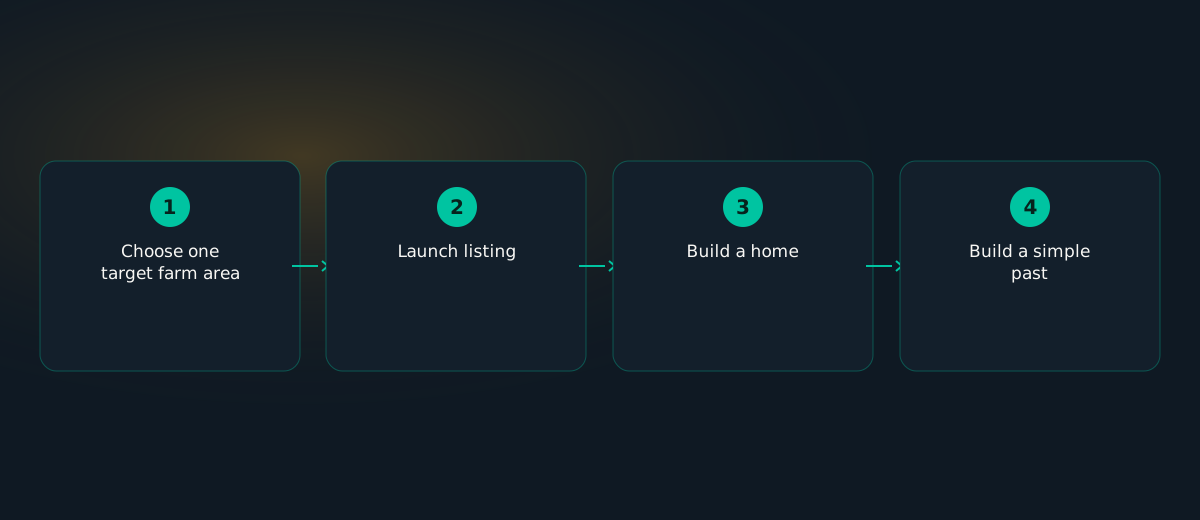
- Choose one target farm area — a specific, defined neighborhood, not "the whole city."
- Launch listing-specific Meta ads for any active listings.
- Build a home-valuation landing page as a lead magnet for seller-side interest.
- Set a consistent monthly farming touchpoint and commit to it for at least 6 months.
- Build a simple past-client follow-up sequence.
Realistic Budgets
| Stage | Monthly budget | Focus |
|---|---|---|
| New agent | $500–$1,500 | Listing ads + starting a farm area |
| Established agent | $1,500–$4,000 | Farm area expansion + past-client nurture system |
| Team / small brokerage | $4,000+ | Multiple farm areas, brand-level campaigns across agents |
Adjusting Budgets for Your Market
The figures above are illustrative starting points from a US-style market. Real estate ad costs vary enormously by country and by segment (luxury vs mass-market), so treat these as a rough starting multiplier and calibrate against actual local CPCs rather than converting currency 1:1.
| Market | Rough starting budget (new agent) | Notes |
|---|---|---|
| US / Western Europe | $500–$1,500/mo | Figures used elsewhere in this handbook |
| India | ₹15,000–₹40,000/mo | Lower CPCs generally, though metro and luxury-segment competition narrows the gap |
| UAE / GCC | AED 2,500–7,000/mo | Real estate is one of the highest-CPC categories in the region — often at or above US costs, especially in Dubai |
Zephra's free audit calibrates budget recommendations against live local CPC data for your specific market rather than a fixed benchmark.
Personal Brand vs Brokerage Marketing
Brokerage-level marketing typically builds broad awareness and lead volume across many agents, while an individual agent's personal brand usually converts at a meaningfully better rate for leads specific to that agent, since brokerage-generated leads are typically shared or rotated among many agents rather than exclusive.
Lead Response Operations & SOPs
Buyer lead response SOP
1. Respond within 5 minutes for any digital inquiry — buyer leads convert heavily on speed.
2. Confirm pre-approval status and timeline in the first conversation.
3. Send 3 comparable listings within the hour to keep momentum.
4. Schedule a showing before ending the first call where possible.
Seller inquiry SOP
1. Respond same-day, but prioritize a thoughtful, unhurried tone over speed alone.
2. Offer a no-pressure home valuation as the first step, not a listing pitch.
3. Log the inquiry and trigger event (if known) in the CRM for long-term nurture.
CRM & Nurture Workflow
| Stage | Action | Timing |
|---|---|---|
| New lead logged | Buyer/seller tagged, source noted | Immediately |
| Contacted | Call/message per SOP above | Within 5 min (buyer) / same day (seller) |
| Active (showing/valuation) | Regular touchpoints through the decision | Weekly |
| Not yet ready | Long-term nurture sequence | Monthly for up to 12 months |
| Closed | Anniversary + referral ask sequence | Ongoing, yearly |
Fair Housing and Disclosure Compliance
Real estate advertising commonly falls under fair housing or anti-discrimination rules that restrict how ad targeting and copy can reference protected characteristics, alongside license-disclosure requirements and accuracy requirements for listing details and pricing. Confirm current rules with your local real estate regulatory authority before launching targeted campaigns.
Market-Type Variations
| Market type | Primary emphasis |
|---|---|
| Suburban / family homes | Local farming + school-district content |
| Urban / condo market | Listing ads + portal visibility, faster transaction cycle |
| Luxury / high-value | Personal brand + referral network over volume ads |
| Investment / rental property | Targeted content for investor buyer profiles, cap-rate messaging |
AI Implementation Roadmap
| Phase | Use case |
|---|---|
| Phase 1 | AI-drafted listing ad copy and monthly farming email content |
| Phase 2 | AI-assisted CRM logging of lead source, trigger events, and follow-up notes |
| Phase 3 | AI-personalized nurture sequences by buyer/seller stage and timeline |
| Phase 4 | AI-assisted market report generation for farm-area monthly touchpoints |
Metrics That Matter More Than Lead Count
Raw lead count is a misleading success metric in real estate. More useful metrics are cost per closed transaction, average commission value by lead source, and farm-area conversion rate over a full year rather than a single quarter.
Digital Presence Beyond Paid Ads
A complete and consistent online presence matters alongside paid campaigns — a Google Business Profile with genuine, recent reviews, a professional profile on any property portal used locally, and a regularly updated "recently sold" page.
Case Study
An agent spending their entire budget on broad-radius Meta listing ads was generating buyer leads at a reasonable cost but had closed zero seller-side listings in six months. Redirecting roughly a third of the budget into a defined, six-block farm area produced one signed listing at roughly four times the average buyer-side commission by month seven.
Decision Matrix
| Situation | Priority |
|---|---|
| New agent, need quick transaction volume | Listing ads and portal visibility for buyer leads first |
| Established agent, want higher-commission deals | Invest in a farm area and seller-side lead magnets |
| Strong lead volume, low close rate | Review follow-up speed and qualification process, not just lead source |
| Uncertain about ad targeting rules | Review current fair housing and platform housing-ad policies before launching |
Common Mistakes
- Spending 100% of budget on buyer-side listing ads with no seller-side farming investment.
- Farming too broad an area with too little consistency to be memorable.
- No past-client follow-up system, losing repeat and referral business.
- Ignoring fair housing ad-targeting restrictions when setting up audience targeting.
- Judging a farming campaign after only a few weeks instead of the realistic 6-12 month horizon.
- No CRM tracking of lead source against closed-transaction value.
Troubleshooting
Plenty of buyer leads, but few closed deals: check response speed and lead qualification process before adjusting ad spend.
Farming campaign showing no response after a few months: check consistency and specificity.
Housing ad disapproved or restricted: review targeting settings against current fair housing / platform housing-ad policy restrictions before resubmitting.
Launch Checklist
☐ One specific farm area chosen
☐ Listing-specific ads live for any active buyer-side inventory
☐ Home-valuation landing page built for seller-side leads
☐ Monthly farming touchpoint scheduled for at least 6 months
☐ Past-client follow-up sequence set up
☐ Ad targeting checked against fair housing / platform housing-ad rules
☐ CRM stages defined for buyer and seller tracks separately
AI Prompts to Speed This Up
- "Write a Meta ad for a home-valuation offer targeting homeowners in [neighborhood], focused on curiosity about current market value, not urgency to sell."
- "Draft a monthly farming email template with a market update section and a recently-sold section for [neighborhood]."
- "Write a 12-month, once-a-month nurture email sequence for a seller lead who isn't ready yet."
30/60/90-Day Plan
| Period | Focus |
|---|---|
| Days 1-30 | Choose farm area, launch listing ads for active inventory, build home-valuation landing page. |
| Days 31-60 | Set up past-client follow-up sequence, launch first two farming touchpoints, review ad targeting compliance. |
| Days 61-90 | Review buyer vs seller lead split and cost per closed transaction; commit farming budget for the next 6-12 months. |
FAQ
What's the difference between marketing for buyer leads vs seller leads?
Buyer leads come from listing-specific ads and portals, converting faster at lower commission; seller leads come from farming and valuation offers, taking longer but usually carrying higher value.
Should individual realtors run their own ads or rely on brokerage marketing?
Both have a role — brokerage marketing builds volume, while an agent's own local farming and referral network usually converts better per lead for that agent.
How much should a realtor spend on marketing per month?
Many individual agents start around $500-$1,500/month, scaling once cost per closed transaction is known.
What compliance rules apply to real estate advertising?
Commonly fair housing/anti-discrimination targeting rules, license disclosure requirements, and listing accuracy rules — confirm current requirements locally.
How long should an agent give a farming campaign before judging results?
At least 6-12 months — the trigger event that turns a homeowner into a seller is unpredictable and can't be rushed.
You can build this split manually using the steps above.
Zephra runs listing-specific buyer campaigns and seller-side farming campaigns from one dashboard, tracking cost per closed transaction across both tracks.
Start Free Audit →Sources & Further Reading
- WordStream — 2026 Google Ads Benchmarks Report — Current cross-industry CPC, CTR, conversion rate, and cost-per-lead benchmarks.
- Google Ads Help — How our bidding algorithms learn — Google's guidance on how its bidding algorithms learn from account data.
Figures and platform mechanics referenced in this guide are cross-checked against the above as of publication; confirm current figures directly with the source before making budget decisions.